View Flat HTML
 View Metadata
 Search Post

Every time and place has its white collar work, and the families that grow into it, like vines on a trellis. "The flowers of civilization", one poet had put them, in a blue-bound book that had resided on the second shelf from the bottom, well within reach of a young boy. Oriol Moya Rubio grew up the son of literate urbanites. His public school classes were supplemented by additional reading and tutoring at home, covering much more than the standard curriculum, and he held the whip more than he was whipped. Polite, well-spoken, perceptive, obedient; he was recommended for seminary, and his parents celebrated, the first time he had even seen them be openly proud of him. Oriol had not come to any firm opinion on the matter himself, but his life had been closely controlled and any thoughts of rebellion did not reach his conscious awareness. He would apply his many talents to the problems put before him, succeed, and climb.
Seminary was different than schooling, different than home; he adapted, came to delight in its subtler cruelties. A wizard only needed to learn their books, but to succeed in the realm of people required much more. Intuition must be trained as well as logic, relationships developed and reputation earned as well as knowledge learned. He devoured the theological library, engaged in barbed discussion with classmates, and respectfully asked questions of his teachers.
But they all knew their tests were imperfect and secondary. The most important test was overseen by their mighty Lord himself, and Oriol was in the bottom fifth. But the bottom fifth of the survivors, those who perished forgotten unmissed by their classmates, and so he was duly slotted into the church bureaucracy.
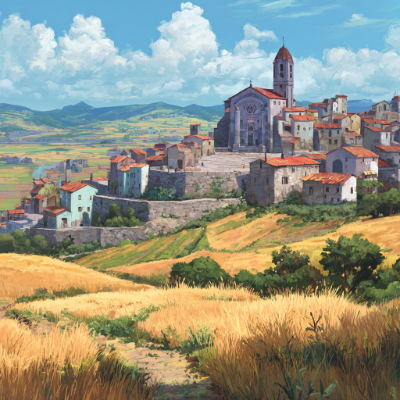
It was a minor post, the parish priest of Soses; one of the many agrotowns scattered across Cheliax. He dimly recognized the duchy of Fraga as being in the Heartlands, and its duke as being one of the many that resided in Egorian, but the land itself had not caught his attention, and he couldn't find it on a map. (As a cleric, he could have requested a map, but he did not need to know and so one was not provided him, and his curiosity did not bend in that direction. How could he better serve his lord and climb the hierarchy by knowing where Soses was?)
The old priest stayed on for a week to situate him, and then left for Egorian. Oriol was dimly aware of the constellations within the church's hierarchy, and did not think Marcos had any reason to favor him, and so he treated the advice with care. It could be a test, or a subtle joke at his expense; best to observe carefully on his own.
He quickly had the measure of Soses. A bit less than a thousand people dwelled within its walls; less than a hundred of them worked 'on the hill', the rest walking out every day to the surrounding fields. Of those hundred, less than ten were worth his careful attention. The bailiff, responsible for the Queen's Justice and the collection of royal taxes; the miller, one of the richest men in town, the owner of the general store, the schoolmaster, and the laundry wizard. He wouldn't do anything as crude as a formal group with regular attendance, but he set about a series of dinners where he would only invite two or three of the five, attempting to cultivate them into worthwhile conversational partners. It was an exercise in disappointment; they did not know the opera, did not get his references. What intellectual life he retained was conducted by letter. The temple staff (one local acolyte, and a handful of halfling slaves) were different, resources instead of allies. The acolyte had not caught the eye of either Asmodeus, the teacher, or the clergy, and Oriol would continue to alternate between dismissive and domineering.
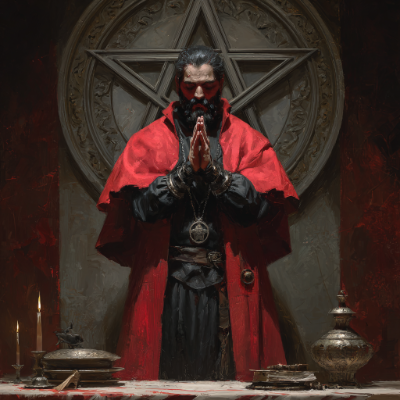
The fields supported the town, and grain flowed out in taxes; sustaining the army and the cities. When the lord or crown called for levies, sons would be sent from the farms, and an important part of Oriol's job was ensuring they didn't just send the lazy and the lackwits. The school was not impressive, but every few years a student would be sent on to preparatory school, and fewer still would come back. At the top of the hill was the temple, with its stained glass and its torture chambers and its cistern, which was connected by a series of pipes to other cisterns lower on the hill. Gates had been installed decades ago, so that the temple could ensure tithes were being paid neighborhood by neighborhood. Much of Oriol's time was spent filling the cistern, a meditative activity that he couldn't read during but could think about the townsfolk and their petty lives and their petty dramas. He did what he could to turn them towards Law, and what he could to turn them towards Evil. They were Asmodeus's possessions, and must be prepared for him.
Six months in to his appointment, he was reflecting on a farmer's confession of unusually reflective worries about his failings. The animals were sick; he did not know why, and while his livelihood depended on the survival of those animals he found himself hating them for the mystery they represented. The advice had been obvious, that he was failing in his duty and needed to be punished; that his hatred towards the mystery should be nurtured and used to defeat the mystery by acquiring knowledge and becoming a better servant. Then Oriol realized: he had been sent here as a rancher, and he too hated his animals. The bailiff was connected, but a farmhand of the state instead of living in the manor of Egorian. He hated that they did not represent any mystery, that he could see; there was nothing to do besides wake up every day and summon clean water and attend to their boring lives and excruciating problems. At least the residents feared him; at least he could operate freely. But he had no opponents worth mentioning, no rivals that made him stronger by clashing with them, or which demanded his creativity to overcome them.