


 View Flat HTML
 View Metadata
 Search Post

"The Hellenic game polis and the Roman game latrones are both centuries older than chess or chaturanga, so there's an even longer history of strategy board games with aspirations of martial relevance. The trouble is, the skills you learn as a novice player don't transfer very well to things that aren't strategy board games. Even though military theory and chess theory have overlapping concepts like 'initiative' and 'maneuvering', they're not entirely the same thing. Worse, the focal point of player development undergoes a phase change around Class B towards memorizing colossal game trees and figuring out how to navigate the branches as they gradually thin out near the extremities. If you try to assess your commanders using their Elo rating as a proxy, at best you're going to run into collider bias. It took a remarkably long time to invent a reasonably accurate simulation game for commanders to train up their fingerspitzengefühl without getting their hands dirty in the field."


That does raise 'magic' to the level of salience, but the arrival of the resurrected Adam Smasher is not one-thousandth as concerning as—

"Why does that one look like, uh, Dark Vador?" asks a second giant dressed in a similar fashion to the first, albeit in horizon blue rather than stain-concealing black.

Even if you couldn't recognize him from the paint job, the 1⁄64-strength aura of crushing despair is powerful enough to demand attention. His cape flutters in Immaterial winds; an ethereal halo burns in the air above his helmet. Alone among his compatriots, the infamous weapons that once menaced the Emperor's person remain by his side. The details on his power armor are immaculate. He is the Praetor of the Luna Wolves, the heir to Horus at the helm of the Black Legion, and the Warmaster of Chaos in the Milky Way. He is Darth Vader, and he is the commander of this army.


Bronwen has a problem. Her problem is not that she has no experience with Warhammer 40,000 – easily remedied if that were the case, she has a copy of the rules and familiarity with other games in the same genre. Her problem is that this is not Warhammer 40,000.
40K is, above all else, a dice game. The outcome of any skirmish is a well-defined normal distribution with a dichotomy based on the stats of the units in play. 40K also uses a victory point system, with the winner determined not only by which army sustains fewer casualties but also by the number of objectives completed. Players can use these numbers to assign payoffs, rank strategies, and enter battle with as much of a mathematical edge as the rules allow you to eke out (at least, Bronwen assumes that's how the game is normally played).
40K without dice or victory points is like a unicorn with wings – obviously fake and not worth worrying about until you find it staring you down, at which point you notice that your mental bucket for impossibilities is conveniently also an excuse to not think about things that would be inconvenient if they were real. It would be inconvenient if your preferred method of handling novel game rules were poorly applicable in certain edge cases, and it would be even worse if your opponent knew that and suggested creating a new game that incidentally has this property while avoiding drawing your attention to it until it was too late to back down. That would be terribly unfortunate, if it happened to you.

So Bronwen paid a visit to the library and checked out a set of nonfiction books on war that came recommended to her by the librarian. Then she returned them all and checked out a completely different set of nonfiction books on war, all of which had been published by Muggles in the last fifteen years.
Several days later, her head swimming with phrases like 'combined arms doctrine' and 'OODA loop' and 'lines of communication', Bronwen has begun to suspect that war has the hallmark complexity of an adversarial problem where every advancement is the result of many clever people putting forth a desperate effort with survival and glory at stake. She is not going to become an expert on any of this in time for it to matter.
Fortunately, she doesn't have to be an expert. These books are mostly describing vast and delicate mechanisms invented to solve problems that are only intractable if you happen to not be a witch. Bronwen is simply going to use magic to solve all of those problems as efficiently as possible, and only then pit herself against whatever Cassian has brewing. It has all the elegance of a plan that might work combined with the simplicity of one she can actually implement; hopefully that will be enough.
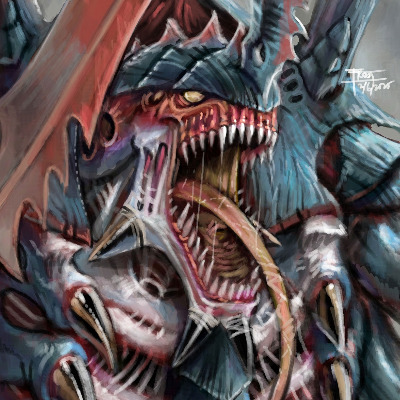
One of the beasts congregated at her feet looks up at her with dumb, uncomprehending eyes. Much like the Chaos Space Marines on the far side of the room, it is simultaneously a finely-honed instrument of destruction and a cheap toy that comes bundled in a pack with eight to twelve basic troops. Unlike those Marines, the lights are on but no one is home. Bronwen hasn't gone to the trouble of giving her Tyranids individuality. They have the alien cunning and brute strength necessary to tear through humans in power armor, coupled with all the initiative of a particularly sessile invertebrate.
This one regards its owner with something approaching curiosity, as though it isn't quite sure whether it is supposed to have feelings or opinions about the situation.

It's not here to have opinions.
An armored division with enough firepower and mobility to assault fortified positions runs on a command and control structure that is, according the books she's read, way too complicated to implement in a game like this. Information needs to flow smoothly from scouts and spotters back to the captain, produce orders that will do at least more good than harm, then be sent back out to whichever section or battery is best positioned to fulfill those orders. The degree of training and organization necessary to accomplish anything at all within a system like that is imposing. It is a requirement that Bronwen would very much like to circumvent, and the Hive Tyrant is the key to her alternative.
All of the available armies have a certain amount of martial competence baked in by the premise, but Tyranids are on another level. Those eight to twelve basic troops are psychically shackled to the nearest squad leader, and each squad leader in turn reports directly to the commander through a full-duplex mental link with such high bandwidth that calling it 'communication' is an understatement. The swarm is a single organism; a many-headed hydra that can fight with all its manifold faculties as easily as any animal moves its limbs. Every unit has the statline of an individual but operates as part of a greater whole. It does not have the command and control problem.
It's not very autonomous, as commanders go. The Hive Tyrant and the other free characters are more intelligent than the Tyranid brood that serve as the bulk of their forces, but more care was put into constructing their bodies than their ability to independently do things. If Bronwen lets them out the way they are, they will happily mill around in their deployment zone until Cassian's army realizes their behavior isn't a feint and massacres them.

Having to coordinate everything with an autocephalous commander defeats the point of aggressively centralizing everything. Looping her into the Hive Tyrant's decision-making process is a waste of time! Not looping her in is also a waste, since she's smarter than the Hive Tyrant and won't get distracted by whatever base urges drive Tyranid swarms. The hive mind she's pieced together is almost the epitome of having a single decision-making organ, but Bronwen's ultimate plan is to take the concept to its logical extreme. She'll only get to surprise her brother with this once, and she's going to make it count.
Bronwen aims her wand at the Hive Tyrant, produces within herself the correct state of mind – it's not hard, she's already focused on the ideal Tyranids represent and that's most of the way there, it just takes a smidgen more mental effort – and casts a spell that little girls are really not supposed to cast.



Most of the Space Marines are too distracted by the arrival of the Warmaster to visibly react to this development, but it is not lost on them that at least two and possibly all three of the giant mutants are potent psykers. Those psykers now among them can sense the ripples of Bronwen's spell in the Warp like the rush of a distant tsunami passing by, along with something else…


This is entirely his fault.
In a distant and trivial sense, this is his fault because Bronwen must've come up with her plan after he told her it was just going to be the two of them and Stephanie, and then he brought Juno instead without giving notice. Has he said or done anything that might give Bronwen the impression that Juno is— yes, obviously he has, he said they were dueling partners, next time he will be more careful about implying someone is a teammate.
In a much more immediate and pressing sense, this is his fault because no one else is going to defuse the situation and expecting otherwise is stupid. Juno hasn't said anything yet but the next words out of her mouth are very likely to be "has your sister just committed an Unforgivable crime?" and he needs a better answer than "technically no" if he doesn't want this to go sideways fast.
He'll have some time to consider this without her input, because Bronwen has to get her second wind before repeating the process for the rest of her synaptic nexus Tyranids.

Cassian is unwillingly somewhat impressed with her tenacity, if not her good judgement.
He considers, briefly, the option of wiping Juno's memory. With the element of surprise and Juno's attention firmly on Bronwen, he's confident he can stun her quickly, erase the last minute or two, and splice in something innocuous. Even if Juno reacted in time to block the opening attack, both of them are keenly aware that he is the better duelist of the two, and Bronwen is not so absorbed in her work that she won't unquestioningly join in once he initiates. The odds of Juno managing to safely abscond from both of them are very low.
The trouble is that she is certain to know one or two of the many post hoc techniques for noticing Memory Charms. If he knew which ones he would feel more confident in his ability to ferret them out, but he's seen enough of them to know that he can't possibly have seen them all. He would need to… compel her to divulge her preparations, then tamper with them recursively to obscure his own handiwork, each layer of memory modification smoothing away the traces of the last until the alterations are hidden forever. It would be painstaking and slow work, and even the slightest mistake would invariably be discovered later and lead back to him. Even if all she knows is that memories are missing, there is no innocent explanation for his behavior here.
Also, he would prefer not to erase her memories. He likes Juno! He doesn't think this is a rationalization either, since "I resisted the temptation to Memory Charm you even though the alternative was really inconvenient" isn't something you can say to convince someone that you view them as a friend even if it happens to be true.
Since he is apparently suffering from a sincere and non-instrumental desire to not hurt Juno, he discards that plan and goes with the inconvenient alternative.
"This really isn't the time to be practicing that," Cassian says calmly.


"Students are allowed to train in resisting the curse, but only under the supervision of a qualified professor," he explains. "It's an elective track inside Defense, everyone with good sense takes it."

"Some students do. How else would we have enough wizards on the other end of the spell? The ministry can't send the entire Auror department here to handle it for us, and only a few professors are strong users of the Imperius Curse – it's not a skill they look for when hiring schoolteachers. Hence the exception to the law about casting an Unforgiveable Curse on a being. The board of governors approved this plan with the rule that students are only allowed to dominate other students while supervised. They didn't say anything about using it on non-beings. Bronwen's army comprises mindless vermin—" unless she has Genestealer Cultists in there, in which case so help him she had better not be enslaving them "— and those are allowed for beginner target practice."

That cannot possibly be— well, maybe? The headmaster is an inscrutable man with a lot of power and a reputation for using it; if he intended to teach his students the Dark Arts in the name of cultivating defense against them, it would not be legitimacy standing in his way. Juno is also forced to admit that, while a normal person might have qualms about authorizing teenagers to learn the Dark Arts, great wizards are not normal people.
It's still all kinds of messed up, though.

Cassian doesn't look very sanguine either. He needs Juno to check that Defence students are allowed to learn Unforgiveable curses, which is true, without further verifying whether Bronwen specifically has an exception to start before sixth year, which she absolutely does not. Not that the professors would answer that question if asked directly by a foreign student, but Cassian would've known.
It is because Cassian would've known that he is especially troubled by this turn of events. His sister has been keeping one hell of a secret from him! When and where has she been learning this magic? It certainly wasn't his doing, and none of Bronwen's other friends and acquaintances are likely to be responsible. It's not impossible that she picked it up on her own from study, but even that seems like a stretch. Which professor could she have convinced to write her a pass for the restricted section? Which forgotten corner of the dungeons has she been keeping her practice rodents in? Why haven't the other girls noticed her sneaking out of the dormitory by night, they way they all clearly noticed her creating a magical Warhammer army?

At first glance, the Imperius Curse is not the ideal tool for hacking together a decentralized hive mind, despite the obvious advantages it has over Legilimency. The reason is made apparent through the minimal setup: if an Imperiused witch attempts to tag back her master with the same curse she labors under, the resonance between the two spells puts fast-mounting pressure on the system for one will to utterly dominate the other. Even with both participants holding out against the attractor state and refraining from throwing off the curse through sheer bloody willpower, the self-oscillatory behavior of the conduit makes it impossible to reliably transmit anything not driven by a primal psychological urge. Trying to operate this way is less practical than not using magic at all and simply yelling at your partner from wherever you happen to be standing.
So the next logical step, if the Imperius Curse Digraph doesn't permit symmetric edges, is to set up a cycle with more than two nodes. If Rose curses Colin, Colin curses Larry, and Larry curses Rose, with no two wizards casting the same spell on one another simultaneously to avoid resonance, what happens?
Bronwen does not have a satisfactory answer to this question. In fact, it's entirely possible that no one has investigated the Oriented Cyclic Imperius Curse Digraph in the history of the spell's existence. Doing so requires at least two interested confederates who are both trustworthy and skilled in the use of mind control, a set of conditions which obtain… infrequently. The research notes of scientifically-inclined Dark Wizards have some useful observations from the perspective of the root node of the Imperius Curse Arborescence, a more appealing graph structure for paranoid practitioners, and from these scraps of forbidden lore Bronwen has guessed at the problem: anyone trying to participate in a gestalt has to do that on top of everything else that's going on, and being part of a superorganism can only lighten the load by distributing it elsewhere. There is a knack to being a productive member of a hive mind, she thinks, certain habits of thought and action that do not come naturally to the mentally isolated. The aspiring hive mind would need extensive practice to reach the pinnacle of this art.