"The Hellenic game polis and the Roman game latrones are both centuries older than chess or chaturanga, so there's an even longer history of strategy board games with aspirations of martial relevance. The trouble is, the skills you learn as a novice player don't transfer very well to things that aren't strategy board games. Even though military theory and chess theory have overlapping concepts like 'initiative' and 'maneuvering', they're not entirely the same thing. Worse, the focal point of player development undergoes a phase change around Class B towards memorizing colossal game trees and figuring out how to navigate the branches as they gradually thin out near the extremities. If you try to assess your commanders using their Elo rating as a proxy, at best you're going to run into collider bias. It took a remarkably long time to invent a reasonably accurate simulation game for commanders to train up their fingerspitzengefühl without getting their hands dirty in the field."


"Kriegsspiel had two key advantages over its precursors. First, it was played on a topographic terrain map rather than a flat board with no features other than the grid. Unit travel was measured in inches and plotted with a straightedge and compass. Second, players interacted with the game by submitting written orders to an umpire. Letting a neutral third party handle the pieces turned it into a game of imperfect information – for example, troops without mutual knowledge of their position could be removed from the board, forcing the players to try and predict enemy movements without worrying about trivially easy cheating. The verisimilitude of having your message to the front lines delayed because you accidentally ordered the messenger to cross two rivers and a minefield on horseback made it popular for teaching as well as just for fun. It also cost a small fortune and used a suite of dice with the outcome of specific attack scenarios written on the faces in painfully tiny font, so when Kriegsspiel escaped from Prussia in the mid-19th century there was still room for improvement.
"Even more than training simulations, commercial wargames need to balance realism against ease of play. This isn't always a direct tradeoff; the newer video games can actually— I'm sorry, do you know what a computer is?"

It takes her a second to place it, but yes. Her mother owns a Macintosh, which she has never really had the time or inclination to interact with firsthand. It only stands out in her memory as the incongruous hunk of beige plastic in the boudoir. She does have an inkling of what it does, though.
"They're a sort of electric typewriter than can talk to one another over the phone lines."

"Among other things," Cassian says dryly. "They're an interface for anything that can be represented as information – text, images, and sound are the most common, but they can also handle rules and game state. In a 'video game' the computer acts like the umpire from Kriegsspiel. It can't improvise, but it can carry out any fully-specified task at high speed. Because they flawlessly keep track of any number of details, games like Harpoon and Panzer General let the player make high-level strategic decisions about tanks and aircraft carriers without anyone needing to roll dice or consult tables of instructions. In fact, because video games don't need to slow down to accommodate complexity, they can compress rulebooks larger than the worst Avalon Hill doorstoppers into an appealing form factor."

The notion of something like a dedicated magic mirror system for information retrieval is intriguing. Could it be done without a computer? The mirror itself would work just the same, but organizing a media library for the transmitter's benefit would make everything much more efficient, maybe even to the point of being worth doing in the first place. Juno files the idea away for later.
"It sounds interesting! I will have to try a video game the next time I'm home. But what does it all have to do with this morning?"

If only he'd known she already had a computer! Alas, an introduction to the wonderful world of PBEM Diplomacy will have to wait.
"Playing by perfectly rigid game rules can only approach total freedom of action. With a computer serving as the umpire those rules can be arbitrarily complicated, but they can't encompass what the creators didn't anticipate or didn't care to include. Those are still important considerations, right? Intuitively it feels like wargames ought to be open-ended enough that innovative play styles can succeed or fail, rather than being impossible in the first place, while still constraining the overall design to a more fun version of what warfare looks like. That's the idea, anyways.
"Today's experiment is a hybrid approach: a real-time strategy game where every unit's particular capabilities are laid out in full detail, where the rules don't exclude anything that unit could hypothetically do, and the game doesn't need human adjudication to determine how long anything takes to accomplish or how effective it will be. It's going to be brilliant."
Or it will be poorly executed and waste everyone's time and enthusiasm, but he's not going to dwell on that.

"A game this brilliant must be played in a secret room with as few witnesses as possible," Juno says solemnly.

"You get me!"
They have reached the secret room – it's not hidden per se, but it's far from any part of the castle still in use and is indistinguishable from any of the hundred other rooms they passed along the way. Cassian gives it the shave-and-a-haircut knock and the lock snaps open automatically.
"After you," he offers.
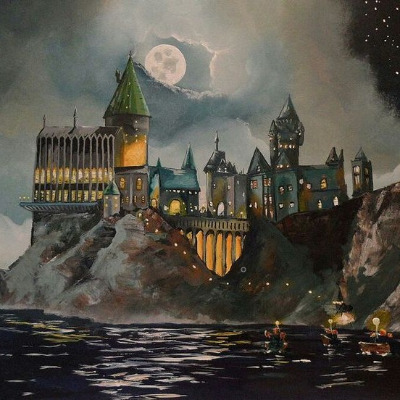
The floor inside is carpeted with thousands of miniature trees, each no more than eighteen inches tall, planted in a layer of actual dirt spanning from wall to distant wall like an enormous garden bed. The leaves blend together into a midnight-green canopy layer that extends halfway across the room until it reaches an indoor lake comparable in surface area and depth to a particularly luxurious bath.
North of that lake, in pride of place at the center of the diorama, is an astonishingly detailed 1:64 scale replica of Hogwarts Castle. Despite its ersatz nature the stonework appears to be made from real stone, the wooden fixtures from real wood. Dim yellow light shines through fingernail-sized glass windows, and glittering rivulets of water flow from the spouts of the outdoor fountains.
Farther north still is picturesque Hogsmeade village, joined to the castle by the road students traverse on thestral-drawn carriages at the start of term. Every square inch of the town, from the eclectic businesses that cater to witchcraft students to the forlorn and decrepit Shrieking Shack, has been recreated as faithfully as Hogwarts itself.
Finally, squatting at the end of the road as it encircles the map is the Hogsmeade train station – not its first time being reproduced at reduced scale, because model train enthusiasts have already gotten to every train station in the country, but perhaps its first time in a hobbyist setup where the railway is not the focus.

And there's a girl! Cassian said they were brother and sister, though there's no family resemblance between them. She's standing over the Astronomy Tower, staring intently into the topmost floor as though there's something wrong with it, with the soles of her shoes resting on the surface of the water. She doesn't acknowledge their arrival.


"It should stand up to some light traffic, as long as you don't kick anything over."

She steps cautiously into the room, carefully avoiding anything that looks like it was crafted with a modicum of intention to detail. Even so, her footfalls leave swathes of flattened grass and wildflowers in her wake. She circumnavigates the lake, indirectly approaching the castle. Does it look any different up close?
It's not just the castle! The low stone wall that encircles Hogwarts is there, complete with a little wrought-iron gate spanning the road. The model groundskeeper's cottage sits near the model Forbidden Forest, as does a bonsai whomping willow. On the opposite side lie the school's Quidditch pitch and the Herbology greenhouses. In addition to the main road, gravel trails and desire paths crisscross the grounds between the courtyards and the rolling green hills. It is a very lifelike scale replica.
Juno crouches next to one of the other towers and peers through the window. What's it got going on inside?
That tower is Gryffindor Tower, and inside it is the Gryffindor common room! It's been kitted out with dollhouse furniture in deep red and gold, big comfy sofas with matching curtains and rugs. All of that is arranged around a beetle-sized mahogany table and backlit by a flickering light coming from the fireplace. There are even paintings hung on the walls. It's totally authentic, as far as she can tell – she probably can't tell, it's not like she's ever been inside the Gryffindor common room – it's certainly very convincing.

It sure looks that way. There are a lot of exterior windows to look through, but for any rooms she cares to check it's easy to see they've been filled with all the odds and ends necessary to give the appearance of habitation by 1:64 scale wizards.

Up close, Cassian's sister looks… tired. Haggard, even. Not like someone guilty of burning the midnight oil too many nights in a row; more like someone who's recently restarted chain smoking to cope with the death of a loved one. The only part of her with any intensity is her gaze, which starts burning a hole in the side of Juno's head as soon as she enters her field of view.
"You're not Stephanie."


In retrospect it would have been smart to tell Bronwen in advance that Stephanie couldn't make it. Time to interrupt Juno before she says something inflammatory.
"Yes, yes, we've met before. This is Juno; she was my partner in Romania last year for the doubles set."

"The Auld Alliance strikes again!" she says, punching the air. "Our victory was never in question. Your brother is very good at what he does, and I am who I am."

The fact that Cassian liked this foreigner enough while paired up on the dueling circuit to give their team a name is good enough for Bronwen. She outsources most of her character judgements to him anyways.
"It's nice to meet you. My brother does not have a girlfriend, he has a white-hot platonic friendship with a human stress ball. There is a sense in which this means he is available."

She laughs. "I am only joking. Cassian told me that Stephanie felt under the weather last night, which is how the topic of your little game came about. He did not invite me; I invited myself."

"He has that effect on people. We didn't rig up any seating for spectators, but the once the game starts the sideline boundaries will be visible. Hope you're okay with standing. There aren't any rules for outside interference, the game just stops if you cross the line before the end."

Good, they're getting along. It's always hit or miss when trying to get Bronwen to socialize with other people. She's only recently graduated from sticking to Cassian's side at all times like a limpet to occasionally wanting total seclusion – not precisely the direction he was hoping for her to grow in, but he'll take what he can get.
He checks his watch. "Shall we get the armies set up? Mine's still in the trunk, I don't know about yours."

"In my pockets. I'll take the far corner." She gets up, swaying gently as though the effort has cost her dearly, then steadies herself and walks away.

Juno does not comment on this. If Cassian thought his younger sister being sickly and adopted was relevant he would've mentioned it. Instead, she follows him towards the trunk. It's shoved into the corner with terrain mounded up against the sides, lid ajar, an open padlock hanging from the rim. Physically on the small side, not that its size matters.
"We've already committed to the units we're going to field," he explains as he removed a tall wooden cabinet from the trunk. "We declared the type of army in advance, so we each had an overview of what could be in the enemy's forces while drafting, but you have to finalize your list without consulting your opponent's list along the way. Otherwise you enter a loop of picking specialized units to defeat your opponent's exact setup, which they can then counter in the same way, and so on. It might be better to have a drafting rule with more flexibility, like alternating choices, but this one came with the game and it works."
He opens the cabinet, sets a single piece of dark plastic on the top shelf, then closes the door again.
"Just going to test this first," he mutters, and locks the cabinet. Then he unlocks it again.

He still has memories of his homeworld, but his clearest memory is of the sky.
They'd begun to reach for the stars long before he was born, relying on massive orbital shipyards and launch platforms as stepping stones into the cosmos. Those titanic arcs of plasteel and tritanium were as visible as the moons and sun, their lambent signal lights flickering across the hulls like artificial constellations in the night. He remembers the sky more clearly than the face of his own mother – a shining symbol of civilization, the combined efforts of myriad races and creeds and nations united under one banner. How could you not know that you lived in a golden age of prosperity when the proof of it was always hanging overhead?
He remembers the sky during the invasion: the arrival of foreign capital ships, the brief exchange of fire, the way the satellites twisted and burned and gradually disintegrated under their own weight as they fell into the atmosphere. As a child he'd been sheltered from the impact of the collapse, though with hindsight he knows the xenocide would've been carried out swiftly after the Federation surrendered to the Imperium. The ancient armies of humanity had outpaced Earth's former colonies in the rush to reclaim the galaxy, and in a matter of years the system and its people were repurposed into engines of that glorious conquest.
Khan doesn't remember why he was chosen. Maybe it was because his parents had invested heavily in his genetic welfare. Maybe it was because he could recite the tenets of the Imperial Truth by heart when prompted by the recruiters. Maybe the recruiters had a quota to fill. Who can say? The rest of his memories from before they crammed five synthetic organs into his cranial cavity and grew him into an instrument of war are blurry and fragmented.
His experiences are disjointed. Endless years spent lurking in the depths of an unknowable monstrosity of a space ship; battles fought on the surface of a hundred planets, against a thousand foes. Khan's life, extended far beyond its natural span, became a homogeneous procession of tedium and slaughter. Home faded behind him until it was nothing but the burning sky and a feeling of deep-seated loathing for everything the Imperium stood for.
The irony is, turning to Chaos had been almost exactly the same: a brief period of becoming something more, followed by an interminable slog between worlds in the carcass of an ancient ship, accompanied by a legion of delusional maniacs. The hope of personally taking revenge for long-forgotten Ceti Alpha died after mere decades, but at last even the final embers of his desire to build anything good or righteous in this universe have begun to dwindle. Orbital shipyards never seem to last.
It is in the midst of another bout of maudlin introspection that Khan finds himself staring up at…

A mutant! Though he has the form and proportions of a baseline male homo sapiens, he stands nearly 400' tall, clad in dark robes cut from an impossible volume of black fabric. In one hand he holds a log from a massive fallen tree, and in the other he holds what appears to be a Land Raider.
Khan is a veteran of several campaigns spearheaded by daemon princes, so he has precisely the survival instincts he needs for this situation. He immediately prostrates himself before the skyscraper-sized psyker, or as close as he can manage while wearing power armor. The hip joints are too bulky to support the range of motion needed to touch the faceplate to the ground while kneeling, which means that proper deference to one's superiors means going all the way to prone. As an afterthought he removes the helmet, in case this one wants to directly observe him looking down to avoid eye contact.

See, this is why he wanted to start early. Now he has time to troubleshoot before the match starts.
"There's something wrong with it… not a total mobility failure, it was fully animated for a moment there before it fell on its face. Could be one of the tertiary enchantments misfiring, or maybe the core segment is fine but the armor is sophisticated enough qua technology to short out in this atmosphere. I'll try turning it off and back on again, that usually works."

Door closed, locked, unlocked, opened, closed, locked, unlocked, opened.
"All right, how about now?"
He remembers the last twenty seconds of his life, but feels like a book that's been rapidly re-shelved and removed to riffle through again in quick succession. He's standing up once more, helmet back on like he never took it off in the first place, trapped under the questioning gaze of the same titanic mutant as before. Clearly it wasn't interested in grovelling.
"Reactor online, sensors online, weapons online – all systems nominal. Thirteen deployments remaining before mandatory scheduled maintenance."

"Check that you have the full range of motion. You're looking for—" parts of your power armor that weren't assembled properly "—unexpectedly loose or tight joints, panels that won't move, clogged valves, missing parts, any extraneous material or broken pieces…"
What does he think "all systems nominal" means Khan will perform a full diagnostic scan while rotating his arms and legs in place without complaining, in case the mutant does… whatever that was, again. Nothing seems to be off, apart from the fact that at least one person here is very much the wrong size.
"Report: no moderate or severe problems detected, lord. Battery capacity degraded to 85% of maximum, coolants need to be recycled sooner than expected, and several armor plates have minor cosmetic damage."

Cassian has no idea why that works for both computers and magic, but it does work. He relocates Khan to the top of the cabinet and begins stuffing the shelves with all manner of similar plastic miniatures.
He's running Chaos Space Marines in this battle, and not just because he had a blast while kitbashing and painting them. Their scale model of Hogwarts only occupies a small fraction of the floor space, but its magical defenses will make it a strategic linchpin for both players: among other things it blocks teleportation, both inbound and outbound, and it suppresses firearms†. An army that has guns can fight almost everywhere on the battleground, but an army that doesn't need guns has an impregnable bastion to take cover in and sally from. Traditional siege tactics won't help anyone who gets permanently shoved out of Hogwarts during the initial stage of the fight, since they have neither the manpower to construct investments nor any need of external resources even if the castle were besieged. Furthermore, since Bronwen helped build it and knows exactly what it's capable of, the ideal army would also be able to hold Hogwarts against an opponent that naturally wants to occupy it as well.
Chaos fills this niche exceptionally, with such a variety of strong build options that no one-trick pony army list can hope to win within or without Hogwarts proper. He has three flavors of psyker disciplines at his disposal, powerful melee mixup attacks, really good offensive buffs, and a plethora of tools he didn't even pick up but can bluff with should the need arise. Plenty of Chaos divisions don't lose a jot of firepower when they holster their guns, something most Imperial and Xeno factions can't boast of. Space Marines over daemons was a closer call, but big guns and heavy armor were ultimately too valuable to leave out – ignoring Hogwarts entirely is not the optimal play here, but if Bronwen does it anyways he needs to be able to capitalize on the advantage and win, something he can't do if she runs a gunline army and dares him to close in with sword and sorcery.
†The exact nature of Hogwarts' actual magical defenses was changed slightly in the adaptation.
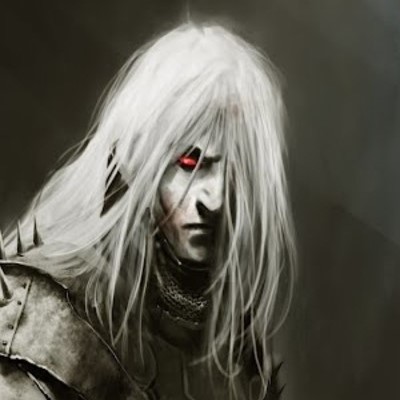
Despite the improbability of what Elric is seeing, this is no illusion. He's been magically summoned to join a platoon in some godsforsaken cul-de-sac of reality where the square-cube law doesn't apply. This is… not categorically impossible? Stranger things have probably happened to someone else, somewhere in the galaxy?

The size discrepancy isn't that surprising – organisms that large only evolve in low-gravity environments, but as a pointlessly humanoid entity this is clearly the product of dark age bionics and a rogue Imperial black budget. What's surprising is the number of Marines who've just appeared in an enclosed space with seemingly no advanced warning. What on Holy Terra is going on? Were they all drugged? Space Marines can survive exposure to ludicrously high poison concentrations, but beyond a point the augmented excretion process itself tends to induce a coma… no, that's not it. Not only does he not feel the aftereffects of sedation, his suit telemetry claims he's not missing any time. So how did he get here so suddenly? Comprehensive illusory environments? Covert teleportation beacons?
("Magic" does not particularly occur to him as a reasonable explanation. Astral projection is a rare skill even amongst legendary psykers deep into the long tail of the distribution; maintaining an astral form for multiple unwilling victims is almost unthinkable.)
Well, however it happened, it was organized by someone who felt capable of abducting a dozen Chaos Space Marines from as many different chapters in one fell swoop. Such brazen overconfidence is… uncommon. As a practical matter, his hand is stayed from retribution. For now.

Yeah, naw. The rangefinder can't seem to make up its mind on the ballistics, but lascannons don't care about drag or bullet drop and the target has exposed eyeballs. Time for some sunshine.

Man-portable lascannons take a few seconds to noisily charge their capacitor banks before firing from a dead stop, which gives him time to react. Not that Cassian is scared of a toy weapon, exactly, but there is a funnier solution than simply ignoring Adam Smasher. He drops the Land Raider on him.
"Glad to see everything is fully mission capable! Would you please leave all of your wargear on the floor before I move you out of the way? Your loadout for today has already been selected, no need to worry about kit or weaponry."
Being flattened by a main battle tank is less debilitating than he was expecting. Sure, every rivet in his power armor popped simultaneously and the pressure inside the dented vessel that holds his remaining organs is creeping towards 75 mmHg as his limbs writhe uselessly against the ground, but he really ought to have been turned into a grease stain. It's almost like the Land Raider is lighter—
The lascannon fires, and a torrent of molten debris from the underside of the Land Raider smothers Adam entirely.

He deserved it. Didn't even try to dodge.
(And even if he had.)
Marines do not easily capitulate, even facing down overwhelming disadvantages that would send lesser men running, but in situations such as these the better part of valor is discretion. Elric unholsters his ancient sidearm, whispers an apology to the machine spirit within for the rude treatment, and lays it atop the small pile of weapons now growing at the front of the cabinet.

Then this batch of newly-disarmed Space Marines can be relocated to the top of the cabinet with Khan. Cassian spares a moment to toss the ruined Land Raider back into the chest and mend the one that destroyed himself before adding another stack of miniatures to the cabinet and repeating the process. The damaged vehicle doesn't matter (it needed to be a Rhino anyways), but the miniatures are important.
His list runs one vehicle, two special characters, five psykers, and seven terminators. The rest of his points have gone to scores of regular units and their wargear. The most obvious exclusions from this list, from the perspective of a real military, are heavy artillery and close air support – both of which exist in the game, but aren't entirely necessary given their high point cost and relatively low damage output.
(It has been three years since Cassian first saw televised combat footage from the Gulf War, a conflict between foes with such lopsided capabilities that the whole affair can only be called unsporting. In Cassian's view, the future of nonmagical war is an oncoming technological marathon to develop weapons that can identify and kill targets at progressively greater ranges, with progressively less human assistance, at progressively lower prices. The idea of being close enough to an enemy to shoot them with a rifle already seems quaint, and that distance is only going to grow longer. Wargames centered on missile launches and advanced radar systems will no doubt have their day in the sun, but to counteract the obvious incentives they have done some judicious rebalancing. To wit: power armor is harder to penetrate with shells than light weapons, which are less able in turn than chainswords and power fists. Not the cleanest solution, perhaps, but better than turning the Astra Militarum into the only faction worth picking.)
He's also passing on daemon summoning paraphernalia, bikers, defilers, tanks, and dreadnoughts. Nothing that can't fight comfortably in the effect radius of a Chaos battle standard has made the cut. The biggest hit is to his army's overall mobility, but between the psykers, the terminators, and the Rhino, he's comfortable with the amount of rapid response.
Adam is something of a connoisseur of being gratuitously destroyed and reassembled from scraps, but even he is not entirely sure how he went from drowning in slag to virtually unharmed. It's almost as if it never happened in the first place…
That does raise 'magic' to the level of salience, but the arrival of the resurrected Adam Smasher is not one-thousandth as concerning as—
"Why does that one look like, uh, Dark Vador?" asks a second giant dressed in a similar fashion to the first, albeit in horizon blue rather than stain-concealing black.

Even if you couldn't recognize him from the paint job, the 1⁄64-strength aura of crushing despair is powerful enough to demand attention. His cape flutters in Immaterial winds; an ethereal halo burns in the air above his helmet. Alone among his compatriots, the infamous weapons that once menaced the Emperor's person remain by his side. The details on his power armor are immaculate. He is the Praetor of the Luna Wolves, the heir to Horus at the helm of the Black Legion, and the Warmaster of Chaos in the Milky Way. He is Darth Vader, and he is the commander of this army.


Bronwen has a problem. Her problem is not that she has no experience with Warhammer 40,000 – easily remedied if that were the case, she has a copy of the rules and familiarity with other games in the same genre. Her problem is that this is not Warhammer 40,000.
40K is, above all else, a dice game. The outcome of any skirmish is a well-defined normal distribution with a dichotomy based on the stats of the units in play. 40K also uses a victory point system, with the winner determined not only by which army sustains fewer casualties but also by the number of objectives completed. Players can use these numbers to assign payoffs, rank strategies, and enter battle with as much of a mathematical edge as the rules allow you to eke out (at least, Bronwen assumes that's how the game is normally played).
40K without dice or victory points is like a unicorn with wings – obviously fake and not worth worrying about until you find it staring you down, at which point you notice that your mental bucket for impossibilities is conveniently also an excuse to not think about things that would be inconvenient if they were real. It would be inconvenient if your preferred method of handling novel game rules were poorly applicable in certain edge cases, and it would be even worse if your opponent knew that and suggested creating a new game that incidentally has this property while avoiding drawing your attention to it until it was too late to back down. That would be terribly unfortunate, if it happened to you.

So Bronwen paid a visit to the library and checked out a set of nonfiction books on war that came recommended to her by the librarian. Then she returned them all and checked out a completely different set of nonfiction books on war, all of which had been published by Muggles in the last fifteen years.
Several days later, her head swimming with phrases like 'combined arms doctrine' and 'OODA loop' and 'lines of communication', Bronwen has begun to suspect that war has the hallmark complexity of an adversarial problem where every advancement is the result of many clever people putting forth a desperate effort with survival and glory at stake. She is not going to become an expert on any of this in time for it to matter.
Fortunately, she doesn't have to be an expert. These books are mostly describing vast and delicate mechanisms invented to solve problems that are only intractable if you happen to not be a witch. Bronwen is simply going to use magic to solve all of those problems as efficiently as possible, and only then pit herself against whatever Cassian has brewing. It has all the elegance of a plan that might work combined with the simplicity of one she can actually implement; hopefully that will be enough.
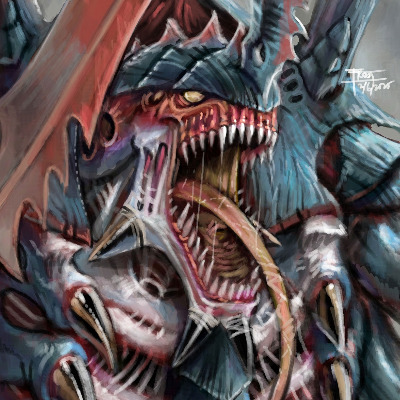
One of the beasts congregated at her feet looks up at her with dumb, uncomprehending eyes. Much like the Chaos Space Marines on the far side of the room, it is simultaneously a finely-honed instrument of destruction and a cheap toy that comes bundled in a pack with eight to twelve basic troops. Unlike those Marines, the lights are on but no one is home. Bronwen hasn't gone to the trouble of giving her Tyranids individuality. They have the alien cunning and brute strength necessary to tear through humans in power armor, coupled with all the initiative of a particularly sessile invertebrate.
This one regards its owner with something approaching curiosity, as though it isn't quite sure whether it is supposed to have feelings or opinions about the situation.

It's not here to have opinions.
An armored division with enough firepower and mobility to assault fortified positions runs on a command and control structure that is, according the books she's read, way too complicated to implement in a game like this. Information needs to flow smoothly from scouts and spotters back to the captain, produce orders that will do at least more good than harm, then be sent back out to whichever section or battery is best positioned to fulfill those orders. The degree of training and organization necessary to accomplish anything at all within a system like that is imposing. It is a requirement that Bronwen would very much like to circumvent, and the Hive Tyrant is the key to her alternative.
All of the available armies have a certain amount of martial competence baked in by the premise, but Tyranids are on another level. Those eight to twelve basic troops are psychically shackled to the nearest squad leader, and each squad leader in turn reports directly to the commander through a full-duplex mental link with such high bandwidth that calling it 'communication' is an understatement. The swarm is a single organism; a many-headed hydra that can fight with all its manifold faculties as easily as any animal moves its limbs. Every unit has the statline of an individual but operates as part of a greater whole. It does not have the command and control problem.
It's not very autonomous, as commanders go. The Hive Tyrant and the other free characters are more intelligent than the Tyranid brood that serve as the bulk of their forces, but more care was put into constructing their bodies than their ability to independently do things. If Bronwen lets them out the way they are, they will happily mill around in their deployment zone until Cassian's army realizes their behavior isn't a feint and massacres them.

Having to coordinate everything with an autocephalous commander defeats the point of aggressively centralizing everything. Looping her into the Hive Tyrant's decision-making process is a waste of time! Not looping her in is also a waste, since she's smarter than the Hive Tyrant and won't get distracted by whatever base urges drive Tyranid swarms. The hive mind she's pieced together is almost the epitome of having a single decision-making organ, but Bronwen's ultimate plan is to take the concept to its logical extreme. She'll only get to surprise her brother with this once, and she's going to make it count.
Bronwen aims her wand at the Hive Tyrant, produces within herself the correct state of mind – it's not hard, she's already focused on the ideal Tyranids represent and that's most of the way there, it just takes a smidgen more mental effort – and casts a spell that little girls are really not supposed to cast.


Most of the Space Marines are too distracted by the arrival of the Warmaster to visibly react to this development, but it is not lost on them that at least two and possibly all three of the giant mutants are potent psykers. Those psykers now among them can sense the ripples of Bronwen's spell in the Warp like the rush of a distant tsunami passing by, along with something else…

This is entirely his fault.
In a distant and trivial sense, this is his fault because Bronwen must've come up with her plan after he told her it was just going to be the two of them and Stephanie, and then he brought Juno instead without giving notice. Has he said or done anything that might give Bronwen the impression that Juno is— yes, obviously he has, he said they were dueling partners, next time he will be more careful about implying someone is a teammate.
In a much more immediate and pressing sense, this is his fault because no one else is going to defuse the situation and expecting otherwise is stupid. Juno hasn't said anything yet but the next words out of her mouth are very likely to be "has your sister just committed an Unforgivable crime?" and he needs a better answer than "technically no" if he doesn't want this to go sideways fast.
He'll have some time to consider this without her input, because Bronwen has to get her second wind before repeating the process for the rest of her synaptic nexus Tyranids.
Cassian is unwillingly somewhat impressed with her tenacity, if not her good judgement.
He considers, briefly, the option of wiping Juno's memory. With the element of surprise and Juno's attention firmly on Bronwen, he's confident he can stun her quickly, erase the last minute or two, and splice in something innocuous. Even if Juno reacted in time to block the opening attack, both of them are keenly aware that he is the better duelist of the two, and Bronwen is not so absorbed in her work that she won't unquestioningly join in once he initiates. The odds of Juno managing to safely abscond from both of them are very low.
The trouble is that she is certain to know one or two of the many post hoc techniques for noticing Memory Charms. If he knew which ones he would feel more confident in his ability to ferret them out, but he's seen enough of them to know that he can't possibly have seen them all. He would need to… compel her to divulge her preparations, then tamper with them recursively to obscure his own handiwork, each layer of memory modification smoothing away the traces of the last until the alterations are hidden forever. It would be painstaking and slow work, and even the slightest mistake would invariably be discovered later and lead back to him. Even if all she knows is that memories are missing, there is no innocent explanation for his behavior here.
Also, he would prefer not to erase her memories. He likes Juno! He doesn't think this is a rationalization either, since "I resisted the temptation to Memory Charm you even though the alternative was really inconvenient" isn't something you can say to convince someone that you view them as a friend even if it happens to be true.
Since he is apparently suffering from a sincere and non-instrumental desire to not hurt Juno, he discards that plan and goes with the inconvenient alternative.
"This really isn't the time to be practicing that," Cassian says calmly.


"Students are allowed to train in resisting the curse, but only under the supervision of a qualified professor," he explains. "It's an elective track inside Defense, everyone with good sense takes it."
"Some students do. How else would we have enough wizards on the other end of the spell? The ministry can't send the entire Auror department here to handle it for us, and only a few professors are strong users of the Imperius Curse – it's not a skill they look for when hiring schoolteachers. Hence the exception to the law about casting an Unforgiveable Curse on a being. The board of governors approved this plan with the rule that students are only allowed to dominate other students while supervised. They didn't say anything about using it on non-beings. Bronwen's army comprises mindless vermin—" unless she has Genestealer Cultists in there, in which case so help him she had better not be enslaving them "— and those are allowed for beginner target practice."

That cannot possibly be— well, maybe? The headmaster is an inscrutable man with a lot of power and a reputation for using it; if he intended to teach his students the Dark Arts in the name of cultivating defense against them, it would not be legitimacy standing in his way. Juno is also forced to admit that, while a normal person might have qualms about authorizing teenagers to learn the Dark Arts, great wizards are not normal people.
It's still all kinds of messed up, though.

Cassian doesn't look very sanguine either. He needs Juno to check that Defence students are allowed to learn Unforgiveable curses, which is true, without further verifying whether Bronwen specifically has an exception to start before sixth year, which she absolutely does not. Not that the professors would answer that question if asked directly by a foreign student, but Cassian would've known.
It is because Cassian would've known that he is especially troubled by this turn of events. His sister has been keeping one hell of a secret from him! When and where has she been learning this magic? It certainly wasn't his doing, and none of Bronwen's other friends and acquaintances are likely to be responsible. It's not impossible that she picked it up on her own from study, but even that seems like a stretch. Which professor could she have convinced to write her a pass for the restricted section? Which forgotten corner of the dungeons has she been keeping her practice rodents in? Why haven't the other girls noticed her sneaking out of the dormitory by night, they way they all clearly noticed her creating a magical Warhammer army?

At first glance, the Imperius Curse is not the ideal tool for hacking together a decentralized hive mind, despite the obvious advantages it has over Legilimency. The reason is made apparent through the minimal setup: if an Imperiused witch attempts to tag back her master with the same curse she labors under, the resonance between the two spells puts fast-mounting pressure on the system for one will to utterly dominate the other. Even with both participants holding out against the attractor state and refraining from throwing off the curse through sheer bloody willpower, the self-oscillatory behavior of the conduit makes it impossible to reliably transmit anything not driven by a primal psychological urge. Trying to operate this way is less practical than not using magic at all and simply yelling at your partner from wherever you happen to be standing.
So the next logical step, if the Imperius Curse Digraph doesn't permit symmetric edges, is to set up a cycle with more than two nodes. If Rose curses Colin, Colin curses Larry, and Larry curses Rose, with no two wizards casting the same spell on one another simultaneously to avoid resonance, what happens?
Bronwen does not have a satisfactory answer to this question. In fact, it's entirely possible that no one has investigated the Oriented Cyclic Imperius Curse Digraph in the history of the spell's existence. Doing so requires at least two interested confederates who are both trustworthy and skilled in the use of mind control, a set of conditions which obtain… infrequently. The research notes of scientifically-inclined Dark Wizards have some useful observations from the perspective of the root node of the Imperius Curse Arborescence, a more appealing graph structure for paranoid practitioners, and from these scraps of forbidden lore Bronwen has guessed at the problem: anyone trying to participate in a gestalt has to do that on top of everything else that's going on, and being part of a superorganism can only lighten the load by distributing it elsewhere. There is a knack to being a productive member of a hive mind, she thinks, certain habits of thought and action that do not come naturally to the mentally isolated. The aspiring hive mind would need extensive practice to reach the pinnacle of this art.

So it's a good thing this hive mind doesn't comprise humans.
There is a growing presence in this room, rippling across the Warp as the silvery cords linking mind to mind continue their process of self-assembly. One that strains against the conceptual bounds of conceptual bounds, yearning to break free into the realm of baryonic matter. One that instinctually lurks at the far edge of perception, detectable only as a trace of apprehension, the lingering absurd fear that a superlatively dangerous phantasm has approached both silent and unseen. Even half-formed it assumes the stance of a confident predator, content to observe until the moment is right from its hiding place in the edges of the graph.
A shadow falls across Hogwarts Castle.
