Accept our Terms of Service
Our Terms of Service have recently changed! Please read and agree to the Terms of Service and the Privacy Policy
Olivia becomes a Hexcaster
+ Show First Post
Total: 162
Posts Per Page:
Permalink

Ahuh. Another one for the Oz Facts list, whenever she manages to retrieve her bag with her own journal-sketchbook. 

She's going to look at the journals first. Did whoever put the TOMES barrel together happen to write anything inside, such as a ships log or maybe a description of a TOME or even a shopping list? (Actually a shopping list would be really cool, implying as it does the existence of shops in Ozland.)

Permalink

No, the author didn't write any of those things. What they did write is:

I seem to have discovered a new method of magical arts, in which one draws patterns strange and wild onto a hexagonal grid. It fascinates me. I've decided to start a journal of my thoughts and findings. The practitioners of this art would cast their so-called Hexes by drawing strange patterns in the air with a Staff -- or craft powerful magical items to do the casting for them. How might I do the same?

Below that are a series of Encyclopedia-style indexed entries covering a variety of topics — a "crafting pattern" for a staff, musings about the nature of "medea" (the energy that powers spells), and a huge number of "glyphs" and their associated meanings. Apparently the big crystal is an amethyst: a chunk of solidified medea, and also the main component in making a staff.

Permalink

!!! magic !!!

The amethysts Olivia is familiar with are made of quartz, not medea: unless quartz is medea and magic can be cast with ordinary beach sand.

Sounds like she needs a staff to cast any spells. Besides the amethyst, what other materials does the Staff pattern call for, and were all of them packed in the barrel?

Permalink

Making a staff requires wooden planks and three sticks. Also a crafting table, which the book does not explain how to make, but which is probably just a flat surface large enough to arrange everything on, based on the context. None of these things appear to be in the barrel.

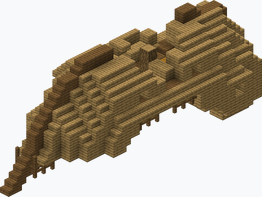
Fortunately, this shipwreck happens to be mostly composed of wooden planks.

Permalink

Fascinating. Olivia's spatial intuition is not coming up with a way to arrange three planks, three sticks, a large crystal, and no other materials or tools in a way that would remotely resemble a staff. Presumably there's magic involved. 

She thinks she can harvest three planks from the interior of this shipwreck without compromising it as monster protection. Three sticks sounds like she can gather them outside, but might need to visit the forest if the scrub is insufficiently stick-having. Without tides, there's no driftwood to gather, alas.

She's not going to leave the ship now, when it could be sunset any time soon. So that leaves ... the tingling books.

Whoever packed the TOMES barrel seems really very friendly, but there's no reason not to be careful. She runs her hands all over the outside of both books, seeing if anything changes about the tingling or if she can observe anything else odd about them.

Permalink

The books appear to shimmer faintly, when held in shadow. Other than that, there's nothing immediately odd about them. The books are titled "Mending" and "Bane of Arthropods", and contain hundreds of pages of text written densely and without spaces in an alphabet that she does not know.

Permalink

Do the characters seem to match up with the dictionary characters in the Hexcasting journals, or is this two separate new alphabets?

Permalink

Yes, actually. The glyphs detailed in the entries in the Hexcasting journal do look very similar to the letters used to write the tingly books. Although a closer inspection will reveal that perhaps a third of the letters in the books do not appear to be defined in the journals, mostly the more complicated and squiggly glyphs.

Also, it turns out that there are a handful of glyphs that are visually identical, distinguished only by the stroke order with which they're written. The glyphs in the books also appear in all different orientations, not written with one specific side facing upward.

Puzzling all this out can certainly occupy her until the sun kisses the horizon, if she keeps at it.

Permalink

She doesn't exactly have much else to do, and it's definitively not safe to be outside the ship at night. Nor is she particularly tired yet, after sleeping for most of the day.

She'll spend not just the rest of the afternoon but a good portion of the night trying to puzzle through the glyphs, and the books written in them. For the glyphs that she was able to find in the dictionary, what sorts of things do they mean? Do the complicated squiggly glyphs seem like they're composites of glyphs she already knows, or fully distinct? What are the most complex, and for that matter the simplest, glyphs that she does have in her dictionary?

Permalink

The glyphs in the dictionary break down into a few different categories. There are "patterns", which seem to be glyphs that are internal to a magical working, manipulating the concepts and structure of the working, and "spells", which are glyphs that cause an actual effect in the world.

Each pattern is named according to a slightly esoteric naming scheme:

Reflections gather information about the world to be incorporated into the spell. The result is referred to as an "iota", and can represent things such as specific beings, items, locations, and more abstract concepts. Purifications transform one kind of iota into another kind of iota. Distillations combine two iotas together. Exaltations combine three or more iotas. Decompositions split iotas in two. Disintegratitons split iotas into three or more pieces. Finally, Gambits seems to be a sort of catch-all category for patterns that do things not easily described by that schema.

Spells don't seem to have a standardized naming scheme, instead being called things like "Explosion" or "Create Water".


The simplest glyph in the book is probably Mind's Reflection, which looks like a diamond, drawn counter-clockwise from one of the pointier corners. It gathers an iota representing the spell's connection to its caster, which can then be used in all sorts of ways to create spells that target things relative to the caster.

The most complicated glyph in the book is ... probably the spell "Flay Mind", on which the author of the journal has this to say:

I cannot make heads or tails of this spell... To be honest, I'm not sure I want to know what it does.

The more complex glyphs are definitely not combinations of smaller glyphs, though. Each glyph is its own stand-alone entity; magical workings are done by chaining glyphs together in sequence, not by actually joining them together. The exception is the infinitely large family of glyphs for representing numbers — each number has its own unique glyph, but it can be broken down into smaller pieces that are still meaningful.

Permalink

So a spell (a casting?) uses Reflections to collect iotas, various other patterns to change iotas, and then a spell-glyph to turn the iota into something actually happening in the world? 

Do spell-glyphs like Create Water need to have iotas? Presumably it'd be difficult to Create any Water without being specific about how much water or where to put it, but perhaps that's Olivia's failure of imagination. For that matter, is it always one spell-glyph per spell-casting?

Numerals! Olivia is delighted to have something so ordinary and recognizable to work with. Are the numeral glyphs Gambits or maybe Reflections? Has Oz invented the number zero yet, or is this more of a Roman numeral type situation? 

Permalink

Spell-glyphs do need to have iotas, yes. Well, most of them. There's a partially complete glyph labeled "Summon Rain" and its sibling "Dispel Rain" that don't appear to need any input.

On the other hand, it is not always one spell-glyph per spell-casting. It is perfectly cromulent to stack multiple spell-glyphs to achieve a more complicated effect. For example, a single spell-casting could in theory throw the caster up into the air and then summon a temporary platform under them.

The numbers are technically Reflections, yes, because they gather the concept of the number into an iota for subsequent patterns to manipulate. Zero does exist, and there are actually several equivalent ways to write it. The simplest is to draw a diamond starting on one of the obtuse corners and proceeding either clockwise or counter-clockwise, ending with a stroke through the middle of the glyph. That's actually how all numbers begin; the other numbers start from zero and modify it in different ways.

Permalink

Summon Rain? That seems like a promising place to start experimenting before she tries out one of these iota flowchart thingys, it seems like iotas get complicated fast. She will get wet, but let's be real here, she hasn't been completely dry since her misadventure with camping in the Inadequate Ziggurat.

She ... supposes ... 5 is in fact 0 + 5, it seems like a weird way to do numbers but sure.

Does this helpful journal have, uh, safety warnings in case the casting ends up with too few or too many iotas? Gets the iotas backwards so they end up at the wrong spell glyph, for spell castings with multiple? Or for that matter any other safety warnings?

Permalink

Yes, actually! There is an extensive list of things that can go wrong, listed under "Mishaps", and with the writing getting progressively more cramped as it tries to squeeze everything onto the available page. Apparently the author kept discovering new ways that things could go wrong.

The different kinds of mishaps cause different deleterious effects to the caster. Some of them sound pretty unpleasant, but none are permanently damaging. There is a warning that the ancients were capable of harming themselves by casting without a source of amethyst present, but the author of the journal was unable to replicate that.

Drawing an invalid glyph will call up a "nonsense" iota that contains no useful information, as does invoking a pattern with too few iotas, as does completely overwhelming the spell-casting with iotas, as does using the wrong type of iota. Trying to affect something that cannot be affected, either because it is immune or because it is too far away, causes whatever is in the caster's hands to violently fly away.

Dividing by zero causes pain, dizziness, nausea, and lingering malaise that recovers slowly. Targeting a thing that exists and can be affected by the spell, but is the wrong kind of thing causes a phantasmal green explosion. Stuffing too many patterns into a single spell-casting causes temporary asphyxiation. Attempting to bind the essence of a sentient being into a magical item causes temporary blindness.


Of course, all of these are only the problems caused by malformed spell-casting attempts. It is perfectly possible to write a well-formed spell that summons an explosion, or teleports the caster into a wall, or destroys whatever one is standing on. Those possibilities aren't explicitly called out in the journal, but perhaps Olivia can read between the lines.

There is another problem with casting "Summon Rain", though — the glyph for that one is incomplete. It has the shape recorded, but not the starting point or stroke direction, so she would have to brute-force possible combinations to try it.

The journal recommends this as the simplest complete spell, which does nothing:

Mind's Reflection, Novice's Gambit

Mind's Reflection brings in an iota representing the caster, and Novice's Gambit silently discards it, bringing the spell to a close.

Permalink

Indeed, it seems easy to write the spell that explodes oneself, which would be bad in a non mishap sort of way. 

All of those mishaps sound pretty bad! Olivia is motivated to avoid them, so she will of course start with the recommended practice exercise.

Though, if she does the spell correctly, she calls up an iota representing herself, which the Novice's Gambit glyph disperses. If she mis-draws the Mind's Reflection, she calls up a nonsense iota, which Novice's Gambit .. also disperses? How can you tell if you got that part of the spell right? Can you see the iotas somehow while you are casting the spell?

If she mis-draws the Novice's Gambit, she gets a self iota and a nonsense iota and no spell glyph, and what happens? Hopefully her actual self doesn't turn into nonsense, that should really merit a warning! Maybe that's the same thing as dividing by zero?

Permalink

The book doesn't explicitly answer either of those questions, but re-reading the section on how to actually draw patterns with a staff and on mishaps suggests that yes, the caster can perceive the iotas as they flow through the spell. Although "flow" is maybe the wrong word — the section that explains the Novice's Gambit contains a bunch of patterns that serve to re-arrange the active iotas. So perhaps it's more correct to think of the iotas in a spell as being stacked on top of each other, with patterns and spells accessing the iotas that end up on top.

If she ends up with a self iota and a nonsense iota, nothing actually happens as long as she doesn't try to feed them into a spell-glyph. The casting won't be complete, but she can try drawing the Novice's Gambit again to get rid of the iotas. Once there are no more, the casting ends without any additional effects.

It would be pretty hard to mess up drawing the Novice's Gambit — it's a single sixty-degree angle.

Permalink

Okay, if it's just "keep drawing Novice's Gambit until she succeeds at it enough" that sounds a lot more doable.

A project for tomorrow after she's made her staff. For now: sleeping.

On this second night, are there once again circling monsters outside of her shipwreck-sanctuary, or has she evaded notice enough by being "inside" since before sunset?

Permalink

The monsters do reappear — a spider spends a while jumping around on the roof — but since she hasn't dragged a whole horde of them through an entire biome, they're considerably sparser and mostly over on land and not on her ship.

Permalink

Good enough, really. It's them  not getting inside the ship that matters the most, but the farther away the better, when it comes to monsters.

In that case, she will wake with the sunrise, yawning and considering her plans for the day. 

Magic! Also fishing (again). She badly wants to try to retrieve her bag, abandoned the night before last in that horrible chase, but it would likely be wiser to explore some more and see if she can find another food source, perhaps in the northern forest. Decisions, decisions.

Permalink

The shipwreck doesn't have any particular comment on which way she should look. There is a handy pile of bones sitting on the keel if she wants to try exploring while holding onto bones for some reason.

Permalink

Unfortunately, Olivia has but two hands and zero bags, so carrying anything is a bit fraught.

That's actually a pretty good argument for bag today, forest tomorrow. Olivia sets off down? up? Away along the river.

She had abandoned the bag at the start of the night, on the southern shore of the river near the Inadequate Ziggurat.

She had spent most of the night swimming, but accounting for swimming being slower than walking, she thinks she should make it to the bag's location before noon, and so back to the shipwreck before dark. Though perhaps not in time to eat today. (It's okay. Not ideal, but she can plan to have two meals tomorrow.)

Eventually she thinks she's going to want a bucket to hold live fish so she doesn't have to eat them immediately after catching them. And if she's really dreaming, maybe she can even get the magic to start a fire safely, and then she can have cooked fish.

Daydreaming about cooked food will occupy her mind for much of the morning, unless something else catches her attention.

Permalink

The river turns out not to slope up or down at all, but it does wend side-to-side, so she can actually make reasonable time by cutting off some of the turns. The scrubby grassland area does not seem to have as many ambient animals as the hills she first arrived in, but it does have a small herd of sheep taking turns to watch over each other as they graze.

There are also plenty of occasional bushes from which she might collect sticks, and at one point an opening into a dark cave.

When she eventually tracks down her bag, the arrow that was stuck in it has disappeared, but it otherwise seems intact. Or at least as intact as it was when she left it, given the panicked swimming with it.

Near her turn-around point there is a distant cluster of probable-buildings on the southern horizon, but if she's focused on her bag she might pass them by.

Permalink

Sticks, excellent. She will pick 'em up and take them with her. 

The bag is not actually too damaged, all things considered! There's a big gash where the arrow punched through, and some of the contents are arrow-damaged as well. But she had tried, and apparently succeeded, at keeping it dry, so her sketchbook is scratched but intact. Also, helpfully, the weather has been dry and sunny the whole time she's been here.

Among the various cruft in this bag is a small roll of duct tape, bright yellow, that Olivia had gotten on a whim and then never used. She doesn't have any kind of knife or scissors, but with sufficient determination she can tear the tape with her teeth and fingernails, rigging up a raggedy but functional patch for the arrow-hole.

The umbrella she was using as a makeshift weapon is nowhere to be seen, and Olivia doesn't clearly remember what she did with it, so it's unlikely she'll be able to find it again. Possibly one of the monsters that night took it? Or it ended up somewhere at the bottom of the river.

Permalink

Olivia's in a hurry to get "home" to her ship and start experimenting with magic! No side quests into possible buildings even if she was thinking about them, not today.

Besides, they're probably abandoned, like the ship and the Inadequate Ziggurat. (Olivia hates that Ziggurat so much. She had tried to select a cautious and safe campsite. And it failed her.) Without a guarantee of a place to overnight, Olivia's planning to do her best to avoid getting more than half a days walk from her ship.

She stows the sticks in the bag and starts walking shipwards. Roughly eastward?

Permalink

Indeed! It is east and very slightly north, and still waiting for her when she gets back to it.

Say — does she have any idea what wild wheat looks like? Because there is some wild wheat growing among the grasses on her walk back. Otherwise she might have to fight another fish. One large raw salmon per day is not really enough after swimming an entire night away.

Total: 162
Posts Per Page: