Accept our Terms of Service
Our Terms of Service have recently changed! Please read and agree to the Terms of Service and the Privacy Policy
Merrin trying to survive on a dangerous exoplanet
Next Post »
+ Show First Post
Total: 547
Posts Per Page:
Permalink

....Actually, that's worth more thought. 


Most of her field lab-test kit is too specific, for the obvious reason that she has never once needed to test a human patient to see if they're made of the same kind of protein as other humans and dath ilani organisms more generally, she's needed to test things like "do they contain enough of this one very specific protein related to blood clotting", etc etc. (She has ever done "mystery alien patient" training sims, but she had a totally different equipment setup, and it was a big-city-hospital exercise not a solo-wilderness-rescue sim, and she had an entire hospital lab full of specialists who could give her answers to higher-level questions, she didn't have to do the chemistry herself.) 

The most promising elements of her kit are:

1. Urinalysis strips. Among other indicators, they can detect an abnormal concentration of protein in urine. And that's pretty non-specific! She'll have to go read the fine print in her digital reference manual, but it's probably doing something involving testing for amino groups in general. It'll be calibrated to react to human albumin proteins with the most sensitivity, but she doesn't really need to worry about sensitivity if she's sticking directly into finely-pulverized meat slurry and not trying to detect a tiny subcomponent in urine which is mostly water.

2. She has two different kinds of glucose test strips. One is very specific to precisely the glucose molecule, which is normally a good thing. But the specific enzyme reaction used for it, glucose oxidase, is less heat-stable than an older style of test, so she has backups of the other kind of strip in case her kit is exposed to absurd temperatures or something. And the older test system is known to cross-react with maltose (digestible and metabolically usable), galactose (digestible and metabolically usable), icodextrin (slowly absorbed but eventually digestible and metabolically usable), and xylose (not very metabolically usable, but she'll be able to identify if the test was false-positive-ing on that specifically because eating a significant amount will have dramatic GI side effects.) 

Permalink

...The other obvious test is to try to culture some of her own gut bacteria on purified extracts of her various samples. She'll want a control, to see if they grow more slowly indicating that the sample is either mildly toxic or only partially metabolizable, but she can sacrifice one (1) ampoule of 50% dextrose solution, it's not like it's very many calories to lose out on, and she does have a compact microscope kit with some slides to examine the growth resulting. 

Permalink

(Her spectroscope did think the "wet biological" samples had approximately the correct ratios of, like, carbon and nitrogen and stuff, to be animal tissue. But that's very nonspecific, and she can already guess it's true based on the visual appearance. They might still happen to all or mostly be the wrong chirality for her body to digest, or something.) 

Permalink

For now, though, time to go slightly-cook and then properly dissect her giant snail! And see if it's lower uranium content than everything else!

Permalink
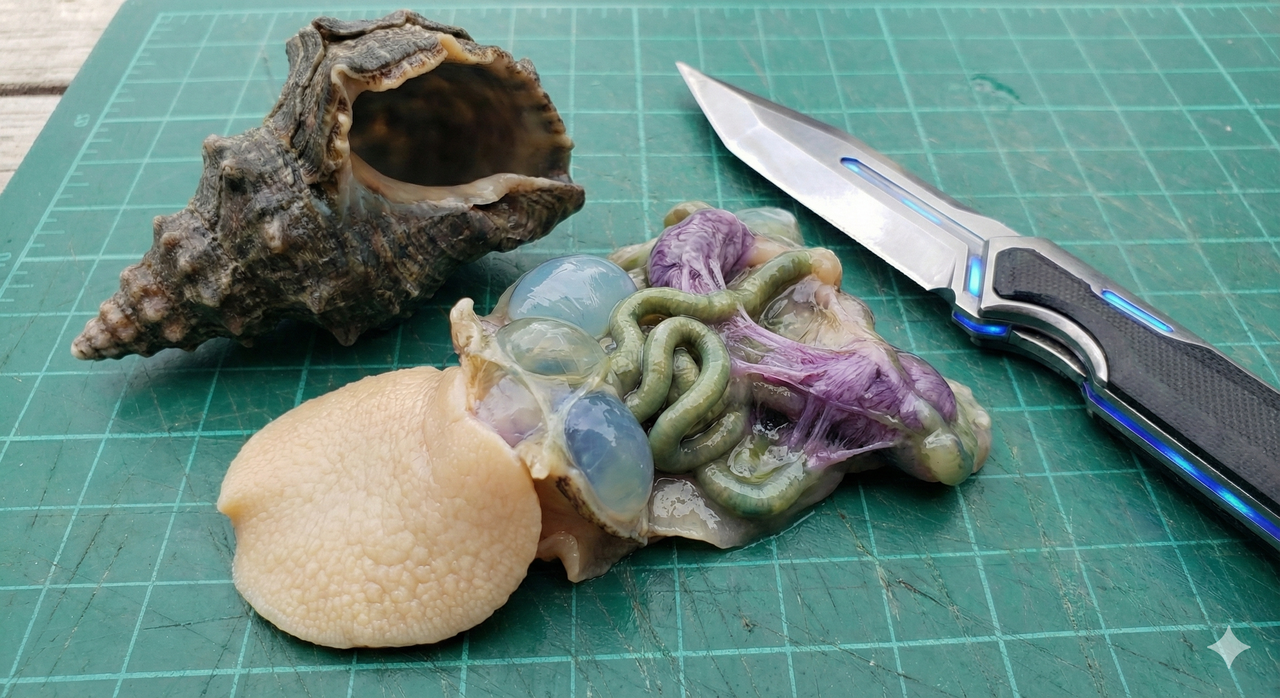
Click for a picture of GROSS GUTS

Permalink

Her sample breaks down as: 1200g of shell, 450g of organs, and an entire 820g of muscular foot. 


The shell has detectable uranium content. The digestive organs, separated out, juuuuust baaaaarely does, after spending a while pointing the spectrometer at her sample.  

The muscular foot, on the other hand, is below the detection threshold on any heavy metals, including those, even when she spends a while scanning it. 

Permalink

!!!!!!!!!!!!!!

Permalink

It makes sense – the bivalves are filter feeders and will process huge quantities of seawater with its mineral contents in the process of extracting some digestible organic matter from it. And the centipede-worm-fish is probably the closest thing this planet has to an apex predator, based on its mouthparts up close. But the snails seem to eat plants only, and they're grazers, not filter-feeders. 


...The mass of organs includes a bladder that seems to maybe be full of some kind of oil? Intriguing! 

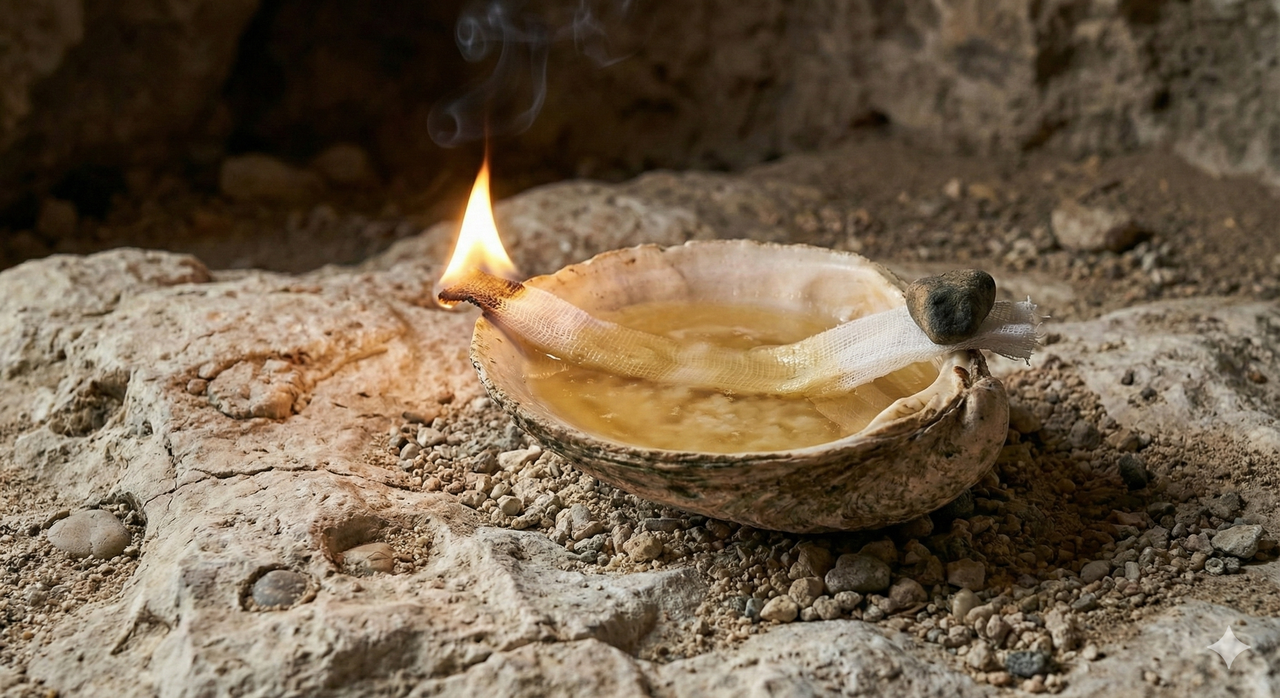
Merrin is going to suck out some with a needle and syringe and confirm that it floats to the top of a small cup of seawater, and then she's going to squirt some more into her emptied bivalve shell as a lamp base, and go get her spark-lighter, and try to light it on fire.

- after a few failures, she thinks to also improvise a strip of bandage into a wick, and try lighting that.

Permalink
Permalink

.....Flammable oil does not guarantee edible oil. Petroleum hydrocarbons would also burn just fine and she cannot digest those. And also she's not sure if she can purify it down to a safe uranium content. 


But it's promising! 

Also: OIL LAMP OIL LAMP OIL LAMP!!!!! It even smells kind of nice!! 

It's not burning incredibly well - on further examination, Merrin is wondering if the "oil" is actually an oil-in-water emulsion, and at the very least it's full of organic impurities - but she can process it further. And then she'll have LIGHT that DOESN'T USE ELECTRICITY. 

Permalink

....Merrin has also been at it for, like, seven hours at this point, and it's still only midafternoon but she's in fact feeling the urge to take another nap. Plausibly doing all that "restful" swimming around at the surface without any supplementary oxygen wore her out more than she realized at the time. It's still, in fact, only her...sixth? Planetary day here? 

She really needs to get on that calendar.

She'll take a nap, and then keep working until it's dark - and afterward by artificial lighting, because she has lots of power and she won't need it for heating or oxygen tonight - and eventually sleep again, and wake in the night and make imaginary people talk to each other in her head as she chews on all of her very many complicated and alarming problems, and eventually she sleeps some more and then it's the seventh day. 

Permalink

She's making progress. 


The snail muscle definitely shows up as protein to a urinalysis strip.

Merrin's gut bacteria grow on it – not quite as well as on the glucose, but there's definitely fermentation happening and they're definitely multiplying. 

She'll test licking it. It tastes...like not very much, actually. Mild, slightly salty. Nothing terrible happens.

She chews a tiny piece without swallowing it for a while. Nothing horrible happens.

On the morning of the eighth day, Merrin risks eating a tiny two-gram portion, cooked in a pot on her tiny electric heating element. (Cooking is insanely power-intensive, her heating element draws nearly 750W, but the solar output is continuing to rise a bit each day.) 

Permalink

....It's not very tasty. It's not bad, just, it's bland and has a weird rubbery texture.


She doesn't suffer any ill effects within the next six hours. (Despite being very, very hyperalert to any strange bodily sensation.) 

Which of course only means it's not toxic to her. Not necessarily that she's getting any nutrition out of it. 

It would be a really stupid exoplanet-survival story if she was just doomed by the chirality of the proteins in the local biomass Merrin continues to be extremely dubious of that style of reasoning. 


She risks twenty grams for "lunch", along with her meal bar. 

Permalink

(She's down to 80 meal bars as of this morning, exactly as predicted for four planetary days later. 79 left, now.) 

Permalink

She's been testing the plants, too.

...She actually suspects she should dig for roots on her next harvest trip. The various fronds she cut turn all turn out to TOTALLY have a sugary pith in the bases of the stems where she cut – a macerated soup of it tests strongly positive to the non-specific glucose test, and weakly positive even on her specific glucose test strips. But it's not much, once she scrapes it out. She suspects the real carbohydrate stores are in buried tubers. 

(The base of the frond doesn't show up at all as containing uranium, so there's that. She can get a very faint reading if she stacks just the dried-out giant sail-leaf cut into rectangles to make a brick of it, and then scans it for, like, ten minutes. But the pith specifically is clean, which makes sense, it's de novo sugars made out of the carbon that used to be water molecules, it's not going to somehow incorporate random uranium the way that filter-feeders do.) 

Permalink

She does, eventually, have enough from the pith of the weird giant sail-leaf she snipped off to grind up into goo and cook and cautiously nibble 2 grams of. 


...It comes out with a slimy texture that she can barely get herself to swallow, but it tastes fine? A little astringent, a little sour, but neither is a flavor she dislikes. It's not especially bitter, and it's mostly faintly sweet with a flavor that isn't quite "vegetable" but that she can definitely imagine getting used to, if it turns out not to make her horribly ill. And maybe she can figure out a way to process it that gets rid of the sliminess. 

Permalink

By evening of the 8th day, Merrin has had twenty grams of each, and is feeling normal! 


Other than paying way too much attention to her physical state and the possible appearance of Symptoms, Merrin spends most of the day on:


1. Improving her still! The IV tubing run underground was better for collecting condensation without just dripping it back into the saltwater, but it's too thin and that's going to be restricting the capture and outflow of her water vapor; it was just quick to assemble and had the advantage of giving her an IV-bag collection spot with a nice accessible port. But given more time and thought, she can combine some of her existing materials – namely, wire to make supportive rings, reusable airtight and watertight sealing strips, and plenty of tough plastic sheeting – to make a whole vapor-catching pipe, as thick as her arm, that nestles in a deep trench and eventually emerges aboveground right at the top of her sinkhole. 

Merrin weaves a basket out of the long-ribbony strapwrack she harvested, lines it with more plastic, and she has a 100-liter freshwater cistern. She can extent the pipe to drain directly into it. Through her freshwater filter, so she doesn't have to worry about cleaning the inside of her now-thoroughly-buried condensation pipe. 

She's drafting a wall calendar for herself, based on the lunar "month", which she's now pinned down to (just under) seven planetary days. Twice a month - full moon and new moon - seem like good times to clean her cistern out, so she can keep the algae and mold out of it and save her limited supply of purification tablets. 

Permalink

2. Trying to fit a function to her data on day-length changes and sun angle and estimate the length of the year!


...Unsuccessfully. Totally unsuccessfully. The problem is that she's trying to approximate a sinusoidal wave, and right now she's on the part where the slope is basically linear. She can calculate exactly how many days are left until the equinox, that's just "at this rate of change, at what point are the day and night of equal length" and the answer is "probably in another twelve planetary days", but she has no way of determining, from that data alone, the axial tilt of the planet, and thus how many days after the winter solstice had already passed when she arrived, which she would need to extrapolate how many days until the summer solstice. 

Actually, the best way to back out any kind of prediction is based on the nature of the sun – it's clearly a hotter sun than dath ilan's – combined with the observation that the planet has liquid oceans and that the annual average temperature at a temperate latitude is, judging from her suit sensor data from her danger cave trip, around 3-5° C (the exact answer depends how much the caves are heated by geothermal and uranium-ore heat rather than solar heat, but absent those factors, deep-cave air temperature should be pretty close to annual average temperature). Which is, in fact, pretty similar to the average temperatures at the same latitude in dath ilan. 

Hotter sun + same temperature = further from the sun. Further from the sun = longer year. 

Merrin spends a while dredging her memory for literally anything she can pin down about stellar classification and total solar energy output, and eventually concludes that the planet is probably at least 1.5ish AU from the star, and the year is at least 250ish planetary days. Which would mean about 62 planetary days between the spring equinox and the summer solstice. 

...She is not at all sure of her math, here, but taking it as input, she thinks the day lengths and peak sun angles are changing faster than they would on dath ilan, if dath ilan hypothetically had a year almost twice as long. Which would imply that the seasonal extremes are more extreme – that the axial tilt is larger. 

Which, as usual, would imply that she has very serious problems. Or will, rather, in something like 75 planetary days. 

Permalink

She sleeps, and wakes in the night and mentally designs more of her glorious, beautiful strapwrack-constructed awning concept.

It's going to be amazing. Imaginary Kalorm thinks it's incredibly cool. Imaginary Laeirthe pokes her relentlessly about actually trying to take measurements of material properties and then do math on her engineering tolerances. She doeesn't waaaaaanna because there is toooooo much maaaaaaath, but it would be really stupid to fuck up on that so she will. GRUMPILY.


She sleeps the rest of the night and wakes up and it's the ninth day. 

Permalink

Her model of the tidal timing is finally accurate to within measurement error, which is probably at this point only fifteen minutes in one direction or another. The tidal bore is the easiest element to time, but it's not exactly a constant interval after moonrise/moonset (her "low tide" marker, it's imperfect but she can't otherwise tell because at low tide she can barely see the ocean.) Makes sense, it's going to be affected by random other factors, currents and winds and...stuff. 

...She also has planetary clock time, now. Midnight is 00:00. Noon is 32:00.

(The day is really close to exactly 64 dath ilan hours; her estimate of solar noon, and her measurement on the sundial, aren't drifting out of sync by an amount she can notice over two days. Merrin has no idea if that's evidence for the Exoplanet Survival Narrative Tropes theory or not. But it does make the math cleaner, that she doesn't have to add a Short Adjustment Hour to her timekeeping.) 


High tide, on the ninth day, arrives about five hours after dawn, and it's approaching ten meters higher than the lowest tide she recorded around Day Six. 

Permalink

...If Merrin's model is right, then the highest tide will be the one tonight, the moon will be full and appear larger than usual, and the next tide after that will be starting to decrease. 


Annoyingly, she's predicting tonight's high tide at 60:15 local time – in other words, almost fourteen hours after sunset. She should be awake, but it's cold by then and she'll want to put on the power armor to go poke at the tide-line in the dark and she's so, so tired of putting the suit on. 


If her model is correct, she'll have another optimal harvest window starting in three planetary days, the morning of Day Twelve. High tide an hour after sunrise, tidal bore 2.5 hours before sunset. She can do a whole harvest mission entirely by daylight. Or she could catch the night tide, go out twelve hours after sunset and come back in the next morning. But it'll be much easier on her circadian rhythm to do it entirely in daytime. She just needs to be careful - and speedy - about unsealing the helmet to eat and drink. It should be okay while she's wearing it, it has a UV-proof coating, though she'll slather on the sunscreen anyway. 

Permalink

She tests a 5g nibble of the centipede-worm-fish flesh; she processed her dead samples on the first day, with freshwater rinsing and then freeze-drying and then sun-drying, and then rehydrating and soaking in freshwater to try to leach out as much of the heavy metals as possible. (She has a lot more freshwater, now, with her cistern and her more effective still. Not enough to bathe, or to want to wash any of her things very often, which isn't ideal, but she's getting 5L a day and she's no longer lowkey dehydrated.) 

It's...different, there's that. 

She tests some of the inner pith of the weird ribbon-strapwrack subspecies (the others were too woody). It's also different. It tastes worse – not as sweet, very faintly bitter in a pine-y way – but the texture is an enormous improvement. Maybe the buried tubers will be genuinely starchy and she can grind them into FLOUR. 


She experiments with rendering down fat from her various samples' organ meat. She's not going to eat it – for one, she did not plan controlled refrigeration for the ones she took apart multiple days ago – but she eventually gets it pure enough to burn in a shell-oil-lamp with an almost smokeless flame. 


For her late lunch, she has an almost meal-sized portion of snail – a second live catch, the first has again gone way too many days with questionably controlled refrigeration – and all she has left of the processed sailweed pith. 

She muses on whether she could ferment sugar-juice into vinegar and pickle the snail in brine and vinegar. It would taste way better, that way, and it would be helpful for preservation. Home canning food is genuinely kind of dangerous, but guess what's even worse: starving to death if she gets hit with a planetary month of storms and has to miss too many harvest runs. Also it's a lot safer with acid and brine. 

Permalink

She does not develop any horrible symptoms. She is really hungry by sunset, which might mean she isn't getting as much nutrition as she should because she can't digest it properly, but it might easily just be that she had a really low-fat meal with inadequate calories for a 30-hour day. 


...She has another meal bar, rather than take the gamble of jumping further ahead on her safety testing of the centipede-worm-fish or the strapwrack flour.

That makes six meals bars in yesterday (Day Eight)'s 64-hour period, and four today. She's down to 70.

And she can't get 6000 calories from local biomass tomorrow even if it's both safe and nutritious, because she's running low on harvest samples, because it turns out her safest harvest window comes about once per lunar month, and not twice like the dath ilani neap tides – because it definitely seems like the tidal variation here is dominated by the moon's orbital eccentricity – and she did not harvest a lunar month worth on the last run.

She might want to try to squeeze in two runs, on Day Twelve and again on Day Thirteen – the second one will involve coming in well after dark, but she already proved that's fine if she has the radio beacon, and it's still working, she just can't guarantee that either that or her suit radio will keep working indefinitely and so she does want to practice a daylight run and see if she can find her river channel again without that guidance.... 

Total: 547
Posts Per Page: